
Stockout
A stockout occurs when a store, warehouse, or factory runs out of usable stock of an item. Retailers also measure on-shelf availability. A shopper can find the shelf empty while a full carton sits in the stockroom.
At four o’clock a baker sells the last rye loaf. The shop stays open until six. Some rye customers will take wheat instead. Others will leave, perhaps to buy tomorrow’s bread elsewhere as well. How much of that business could the baker recover by putting another tray in the oven?
Two afternoons with twelve sales
On Tuesday and Wednesday the bakery opens with twelve rye loaves and has four left at 3 p.m. On Tuesday those four sell within the hour. On Wednesday the last loaf sells as the shop closes.
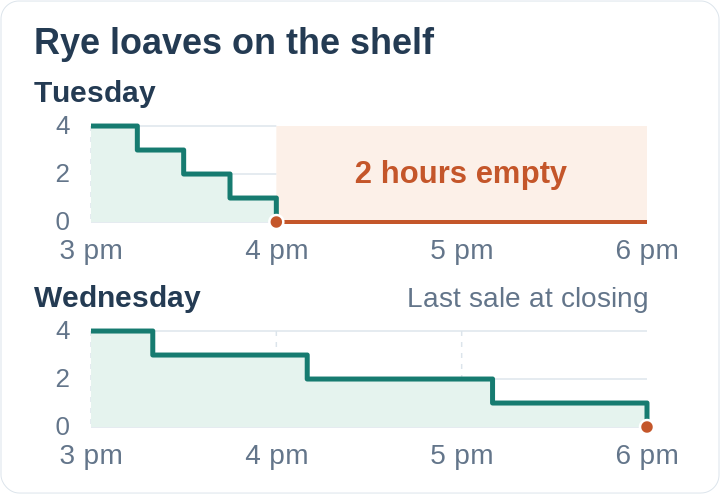
The daily sales report says twelve both times. After 4 p.m. on Tuesday, a dozen people could have come looking for rye, or nobody. Tuesday’s demand is censored at twelve loaves. The baker knows it was at least that high. Using sales to set the next bake can keep the bakery at twelve indefinitely. Every rye customer who settles for wheat also makes wheat look more popular than it is when both breads are available.
Record when the last loaf sells and when the next tray reaches the shelf. Staff can tally customers who ask for rye, though some leave without asking. To estimate missed sales, look for afternoons with similar traffic before four when rye was still available afterward. Relying on all the days with rye left at closing gives quiet days too much weight. A gap between sales can also prompt a shelf check. An hour without a sale is unusual for a baguette that normally sells every five minutes. A specialty loaf can sit there all afternoon.
The last tray of rye
The baker has to decide at four. A tray of six costs $12 in ingredients, energy, and extra labor, and goes on sale at 4:30. Rye sells for $5 a loaf and wheat for $4. There is plenty of wheat already baked. Leftovers of either bread have no value at closing.
Suppose that between 4:30 and closing, two people will want a loaf of rye on a quiet evening and six on a busy one. Half will buy wheat if rye is gone. The other half will leave without bread. Anyone who comes before 4:30 will miss the new tray however the evening turns out.
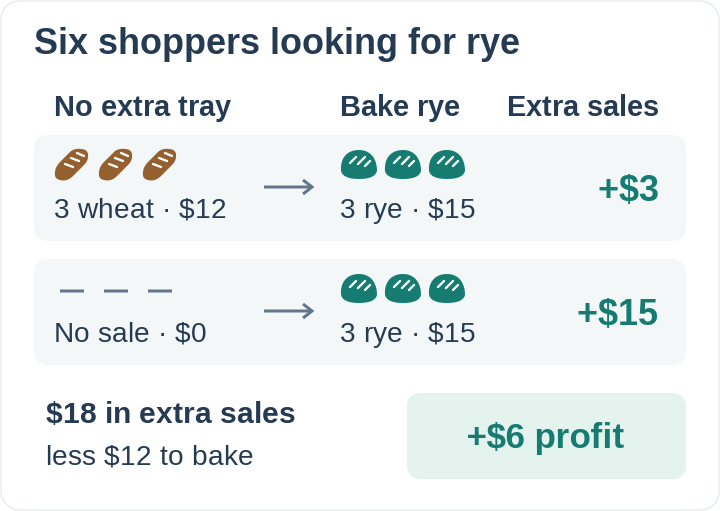
On the busy evening all six rye loaves sell for $30. Three of those customers would have spent $12 on wheat anyway. The tray adds $18 to the day’s receipts, leaving $6 profit after baking. On the quiet evening rye brings in $10 and displaces one $4 wheat sale. Only $6 of the $12 baking cost comes back.
| One extra tray | Quiet | Busy |
|---|---|---|
| Rye sold | 2 | 6 |
| Wheat sales displaced | 1 | 3 |
| Rye left at closing | 4 | 0 |
| Extra profit | −$6 | +$6 |
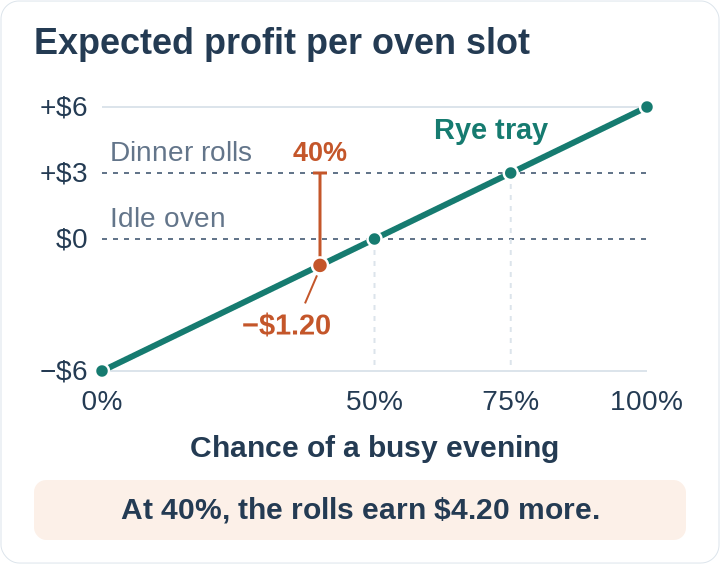
If four evenings in ten are busy, the tray loses $1.20 on average. Look at rye alone and the same tray appears to earn $6. The difference is $7.20 in wheat sales the bakery gives up.
Who gets the oven slot?
Rye breaks even when half the evenings are busy. Now a restaurant calls with an order for dinner rolls. It would earn $3 after costs and use the same oven slot. Even at six busy evenings in ten, rye brings in only $1.20 in extra profit on average. It takes three busy evenings in four for rye to earn as much as the rolls.
The baker can test the effect on today’s trade. On afternoons when rye has sold out by four and the oven is free, choose at random whether to bake the tray. Compare the two groups’ total margin from 4:30 to closing, counting the extra baking cost once. Include anything else people buy with their bread. Someone who leaves without a loaf may take the cheese sale next door too.
A regular who goes home empty-handed may also try the bakery across the street next week. At the original 40% chance of a busy evening, the rye tray keeps an average of 1.8 customers per evening from leaving without bread. If saving each of those sales preserves 67 cents in future margin on average, that covers the $1.20 loss against an idle oven. With the dinner order on offer, rye has to recover $4.20, or about $2.33 per customer. If regulars who settle for wheat also take some of their future business elsewhere, include that loss in the valuation of goodwill.
What can the customer use?
A tile shop can have eleven boxes on the shelf and lose the entire sale to a customer who needs twelve from the same dye lot. A shopper who spots a stain on a jacket cuff may still buy another style in the same size. Food that expires on Thursday is little use to someone shopping for Friday’s dinner. An inventory count can be perfectly accurate in all three cases.
A mechanic may finish a repair on time with a compatible part from another maker. An airline can have the exact part in stock and still face an extra maintenance visit because the spare has too few flight cycles left to last until the next check. If a required part is missing and the aircraft cannot fly, even a cheap spare can hold up passengers on several flights.
On a production line, a late part costs no production time if it arrives before the operation that needs it. Interrupt the feed to a chemical plant, though, and a shutdown can damage equipment and take weeks to recover from. For a hospital treating patients with a drug that has no substitute, continuity of treatment is a requirement. A lost-sales figure gives the buyer little guidance in any of these cases.
What can arrive in time?
Check the shelf and the stockroom before ordering more. If a carton is in the back, put it on display. If it exists only in the records, that phantom inventory may be suppressing the next order. A transfer can help when another store has the item. Allow for what its customers might need before its next delivery, as well as how soon the transfer can arrive.
If the shortage keeps recurring, compare the cost of carrying another unit with the cost of a shorter or more reliable delivery. Offer a backorder to the customer who can wait until Friday. The mechanic with a car on the lift this afternoon may prefer a compatible part today. Raising the price of the last few units can slow sales, where contracts allow it. A regular who remembers what the part cost last week may decide to buy elsewhere.
Timing also tells the baker which decision to revisit. If most customers asked for rye between four and 4:30, even a busy afternoon offers little reason to start another tray at four. Try a larger bake earlier in the day.
The final order
Selling the last loaf as the door shuts is a good finish. A baker who keeps every variety on the shelf until closing pays for that display in unsold bread. A fashion buyer faces a similar choice before the new collection arrives, as does an electronics dealer ahead of a model launch.
Suppose the dealer can buy the outgoing model only in cartons of twenty and expects three more sales at full price. If the other seventeen have to clear below cost, the losses on those units can swallow the margin on the three sales. Skipping that last order leaves the dealer cash to buy the new model.