
Minimum Order Quantity (MOQ)
A minimum order quantity (MOQ) is the smallest purchase a supplier will accept. A mill might quote a minimum in meters of fabric, a carrier in tons, and a wholesaler in dollars. Several minimums can apply at once. A wholesaler might require 24 units of each product ordered and at least $1,000 for the order as a whole.
Suppose you need two units and the manufacturer sells six at a time. Buying the extra four is one option. A distributor may charge more per unit and still give you the better deal. The difference depends on what you can sell before the remaining stock loses its value.
Read the rule before rounding the quantity
Before entering a minimum in the purchasing system, check the supplier’s terms.
| Term | Example | Consequence |
|---|---|---|
| Product minimum | At least 20 units of each ordered item | Order zero or at least 20; 21 is allowed unless another rule forbids it. |
| Order minimum | At least $1,000 per supplier order | Several products can contribute to the same minimum. |
| Group minimum | At least 300 meters of fabric in each ordered color | Products sharing that color contribute to a common constraint. |
| Pack multiple | Full cartons of 12 | Quantities are 0, 12, 24, 36, and so on. |
| Price break | A lower unit price from 100 units | Smaller purchases remain available at the higher price. |
Buyers use the economic order quantity to estimate a lot size from ordering and holding costs. The supplier’s terms determine whether that lot can actually be bought.
With a minimum of 20 units and cartons of 12, the smallest order is 24. One carton falls short. Asking for 20 would mean asking the supplier to break open a second carton.
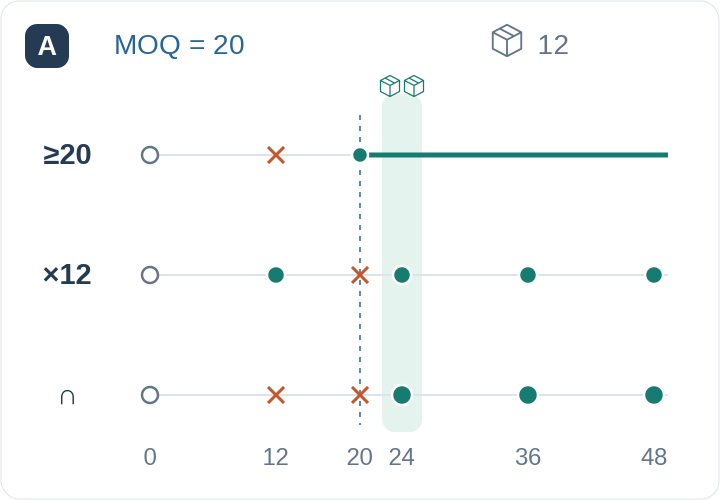
A. Read down the column for 24. Two full cartons clear the threshold of 20. The bottom row marks every admissible choice shown, including zero if the buyer skips the order.
A garment maker may set a minimum per style and another per fabric color. Two styles in navy can draw on the same dye lot. A red version starts a separate tally. Check where the supplier draws the boundary, too. An annual commitment of 3,000 meters permits several deliveries if the contract allows releases. A minimum of 3,000 meters per delivery commits the buyer to the full quantity each time.
Price the entire lot
Suppose a product costs $10 from its manufacturer, with an MOQ of six. It sells for $30. There is no initial stock, and demand over one selling period is uncertain:
| Demand | Probability |
|---|---|
| 0 units | 20% |
| 2 units | 60% |
| 6 units | 20% |
The goods arrive before sales begin. There is one opportunity to buy, unsold stock is worthless at the end of the period, and there are no other costs.
Each of the first two units has an 80% chance of selling. At a selling price of $30, each brings in $24 on average and earns $14 after purchase cost. The next four each have only a 20% chance of selling. Each brings in $6 and loses $4. Taken together, the six units still earn $12 on average.
A distributor can deliver on the same terms and will sell just two for $14 each. The buyer spends $28 and expects $48 in sales. That leaves $20 in expected profit, $8 more than the manufacturer’s lot, with $32 less cash tied up.
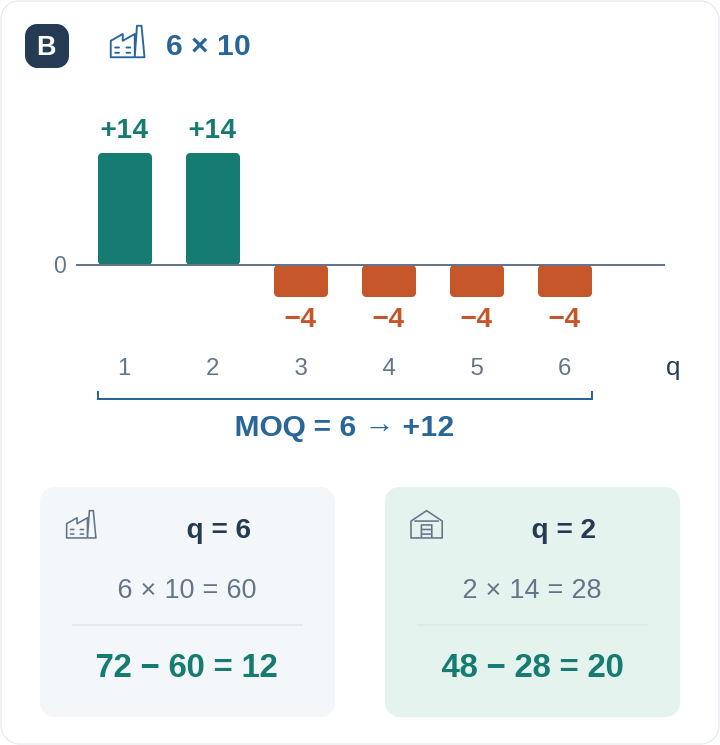
B. Each bar is the expected profit on one more unit bought from the manufacturer. Below, expected sales less the purchase bill give the profit on each offer.
The buyer can use these figures in a negotiation. At $18 per unit, the distributor’s pair would cost $36 and earn the same $12 in expectation as the manufacturer’s six. The two offers still carry different risks. With no sales the buyer loses the purchase price. If all six units are wanted, the manufacturer’s lot earns $120 and the pair at $18 earns $24.
Supplier minimums compete for the same cash
A buyer ranking cartons one at a time can spend the entire budget on paper and still have no order a supplier will ship.
Consider two suppliers, X and Y, each requiring at least four cartons per order. Every carton costs $10, and the buyer has $40. The best four cartons available from X have expected incremental profits of $15, $14, −$10, and −$10; those from Y earn $9, $8, $7, and $6. These values already include purchase cost and uncertainty.
Picking the four highest individual returns selects two cartons from each supplier. Neither order meets its minimum. Completing X’s order earns $9; completing Y’s earns $30. The best first carton belongs to X, but the best affordable order belongs to Y.
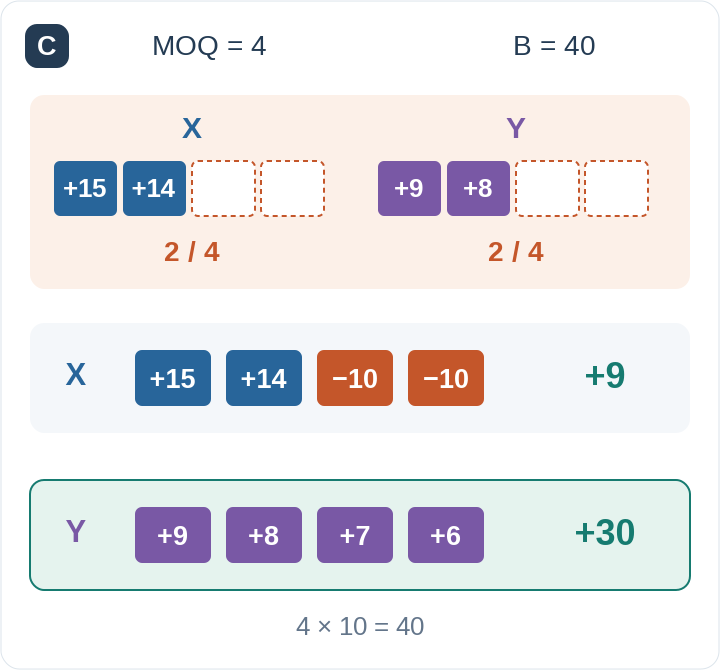
C. The four highest individual returns leave two empty places in each supplier’s minimum lot. The two rows below show what the same budget buys when spent with a single supplier.
A Min/Max calculation might send the buyer two proposals to top up. Checking the minimum flags both proposals. Deciding which one to drop frees the cash to place the other.
What the calculation must compare
Let \(\mathbf q\) be a proposed purchase across products, \(\mathcal F\) the set of purchases satisfying the actual constraints, \(K(\mathbf q)\) the cash required, and \(B\) the available budget. A compact version of the decision is:
\[ \underset{\substack{\mathbf q\in\mathcal F\\K(\mathbf q)\le B}}{\max}\;\mathbb E[G(\mathbf q,\omega)] \]
Here \(\omega\) is one possible future. \(G\) is the money earned in that future after allowing for purchase costs, handling, shortages and the value of leftover stock. The budget limits what the buyer can pay today. For goods that may sit for months, charge for the time that money is tied up as well.
Include the empty order among the feasible choices unless the buyer has already committed to a purchase. Likewise, a minimum for navy fabric applies only to orders that include navy.
Value some items together. The last missing component may make a whole kit saleable. Two substitute parts may compete for the same sale. Forecasting the possible quantities and arrival dates lets the buyer value those outcomes for the order as a whole.
Waiting changes the decision
A buyer short of a supplier minimum can wait until other products need replenishing. The supplier’s lead time starts when the order is placed. Even if the supplier ships just as quickly, the shelves have to cover the extra days.
Suppose six units are available on June 1 and demand is exactly two per day. A receipt becomes usable at the start of its arrival day. The supplier takes three days with probability 70%, or seven days with probability 30%. Ordering June 1 gives a June 4 or June 8 receipt. Waiting until June 4 moves those dates to June 7 or June 11.
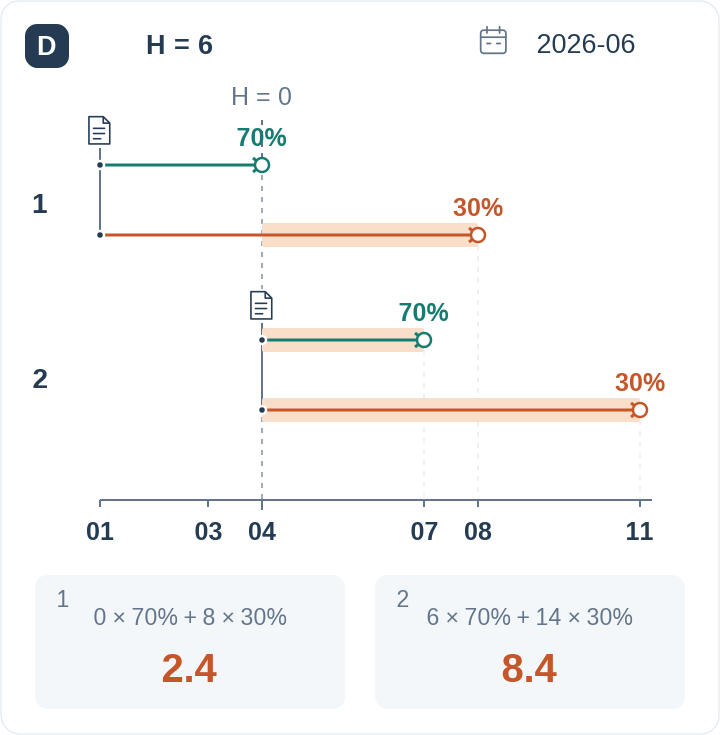
D. The dashed line marks the start of June 4, when the six units have run out. Shading shows the wait from that point until each possible receipt. At two units a day, a June 8 receipt leaves eight units of demand unfilled.
Ordering on June 1 leaves either zero or eight units unfilled before delivery, an average of 2.4. Ordering on June 4 raises the average to 8.4. Waiting therefore costs six extra missed units on average. Their value gives the buyer a price to put against the savings from consolidation. If demand also varies, use the demand that could occur along each delivery path. A buyer who waits may learn enough to change the contents of the order.
Challenge minimums inherited from manual work
Ask who set the minimum and what happens below it. A supplier may decline a small order or quote a surcharge for shipping it. Sometimes the supplier will accept it at the usual price, but the buyer’s own purchasing department has a $500 floor. Lokad calls this last case a soft MOQ.
If the $500 floor dates from an era when a clerk keyed in every order, measure what a small order costs today. Automated ordering may have removed the clerical work while leaving a real cost at the receiving dock. That distinction matters when putting automated purchasing into production.
The supplier’s minimum is also a decision
Manufacturers use minimums to recover setup, material, picking, and shipment costs. A large minimum can reduce those costs while losing customers or pushing them toward distributors. It can also make customers order less often and in larger bursts, shifting difficulty elsewhere in the supplier’s operations.
A customer willing to commit to a production run may still want deliveries in installments. Who owns the undelivered balance if sales dry up? The answer determines how much risk the buyer sheds. A smaller lot at a premium, a small-order charge, or permission to pool styles may be worth more than staggered deliveries.
Produce orders that can be sent
At Lokad, a purchasing calculation selects the supplier, quantities and date together. A practical test is to give the proposal to the buyer who will send it. If the buyer has to add a slow seller in Excel to reach a minimum, find out which term the calculation missed and what the extra stock will cost.
Accepted orders deserve scrutiny too. If the factory ships every lot of six and four units routinely go to clearance, revisit the sales assumptions and ask the distributor for a quote on two.
The research on multi-product MOQs follows a buyer who can place fresh orders as demand unfolds. Introduction to Supply Chain discusses how to value such choices when they compete for the same cash.