






In supply chain management, availability is everything—if you don’t have it or can’t get it fast, you can’t sell or use it. Ensuring the right products and materials are where they need to be, exactly when they’re needed, is one of the biggest challenges in any industry and thus is the subject of one of Lokad’s core modules. This module covers the optimization of decisions meant to procure products and materials, whether those are used as raw materials for complex processes or sold directly to customers.
This subject is classically called “inventory optimization”, misleading people to believe that stock levels (or even worse safety stocks) should be optimized. But let’s be clear: inventory optimization is not about setting fixed stock levels or safety stocks. The idea that there’s an “optimal” stock level that remains constant over time is a misconception—like trying to drive in traffic by maintaining a single “optimum” speed. It simply doesn’t work. Speed will be the result of micro driving decisions that need to be made in an optimized manner. You should think of inventory in the same way. Every procurement decision is a calculated bet, and true inventory optimization means systematically making the best possible bets, every single time.
Key concepts to success
A Smarter Approach to Inventory Decisions
Inventory levels are the outcome of procurement decisions, not the target. Lokad’s methodology doesn’t just balance stock levels—it defines an optimization strategy that dynamically adapts to business realities.
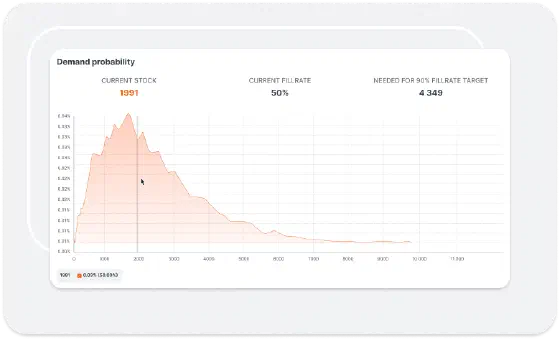
We take a quantitative, financially driven approach, leveraging probabilistic forecasting and machine-learning algorithms to evaluate every purchasing decision based on real financial impact. The goal is to attach a financial gain to each decision and maximize return on investment.
Every unit in stock comes with three key factors:
- Potential revenue—the margin it generates when sold or used.
- Holding costs (costs it will generate until it is sold or used)—capital tied up, inventory carrying costs, and risk of obsolescence.
- Stockout consequences—lost sales, customer dissatisfaction, or service disruptions.
Context Matters: Why One-Size-Fits-All Fails
The balance of these three factors varies drastically by industry:
- Fresh produce (e.g., strawberries): Low margins, high spoilage risk, and minimal stockout impact → Justifies relatively low service levels.
- Aircraft repair parts (PBH contracts): No sales margin (they are not sold), relatively low inventory cost and obsolescence costs, but catastrophic consequences if out of stock → Justifies extremely high service levels.
The Lokad Advantage: Cutting-Edge Tech Meets Deep Supply Chain Expertise
Our solution goes beyond outdated methods. It is built on three pillars:
-
Best-in-Class Probabilistic Forecasting
Leveraging our state-of-the-art M5 competition laureate probabilistic forecasting engine, we provide precise, scenario-based predictions tailored to your dataset.
-
Financial Optimization at Scale
We use differentiable programming to integrate your company’s unique constraints and business goals through a programmatic platform, ensuring every procurement decision is made with financial precision.
-
Supply Chain Scientists on Your Side
Our experts create a digital twin of your supply chain, working closely with your team to model real-world constraints and estimate key financial drivers like stockout costs. They act as a copilot for your supply chain.
What You Get: Smarter Decisions, Tangible ROI
- Daily SKU-level purchasing recommendations with clear financial justification.
- Real-time inventory projections to anticipate stock needs and reduce disruptions.
- Interactive dashboards for decision support, data quality and investigation, reporting, and seamless change management toward a fully automated optimization process.
With Lokad, inventory optimization isn’t about guesswork or rigid rules—it’s about maximizing every decision for financial impact. Let’s transform your supply chain into a strategic advantage.


